
Rising majestically from the heart of Java, Borobudur Temple stands as one of humanity’s most breathtaking spiritual achievements. As the world’s largest Buddhist monument, this 9th-century architectural marvel continues to captivate visitors with its mind-boggling scale and profound symbolism. Imagine walking through history as you ascend through what was originally designed as a ten-level mandala – a colossal stone meditation guide stretching toward enlightenment.
The monument’s brilliant design mirrors the Mahayana Buddhist cosmos, taking pilgrims on a symbolic journey through three realms. At the base lies khamadhatu, representing our earthly existence. As you climb through rupadhatu‘s middle terraces, you leave physical form behind, finally reaching arupadhatu‘s upper platforms where circular stupas symbolize formless enlightenment. This spiritual architecture makes Borobudur far more than stone – it’s a three-dimensional map to nirvana.
Borobudur’s survival story proves just as remarkable as its construction. After centuries hidden beneath volcanic ash and jungle growth, this treasure received new life through a monumental 1973-1983 restoration. UNESCO partnered with Indonesia on this $25 million resurrection, painstakingly dismantling and rebuilding the entire structure stone by stone. Today, this World Heritage Site stands proudly as Indonesia’s crown jewel, attracting spiritual seekers and culture lovers from across the globe.
Borobudur: Java’s Ancient Buddhist Wonder
As you wind through emerald rice fields and bustling villages toward Indonesia’s crown jewel, prepare to step into one of humanity’s greatest architectural marvels. Borobudur Temple (open daily 6am-5pm) isn’t just a UNESCO site – it’s a stone symphony telling stories of enlightenment, lost kingdoms, and artistic mastery. Plan at least two hours to wander its terraces, though many visitors find themselves captivated for half a day.
Imagine this: while Europe built castles and Asia raised pagodas, Java’s Sailendra dynasty created this mountain of wisdom between AD 778-856. Think about that scale – roughly 45,000 artisans worked on what would become the world’s largest Buddhist monument, constructed three centuries before Cambodia’s Angkor Wat and two before Notre Dame’s first stones were laid.
Here’s where history gets mysterious. Despite its grandeur, Borobudur was suddenly abandoned just 100 years after completion as power shifted eastward across Java. While some tales whisper of Borobudur vanishing beneath volcanic ash for centuries, locals actually knew of its presence all along. Javanese royalty even observed a peculiar taboo – princes couldn’t visit the site. When British ruler Thomas Raffles “rediscovered” it in 1814, he wasn’t uncovering a secret, but reintroducing the world to a monumental masterpiece.

Morning light bathes Borobudur’s majestic form © Adel Newman / Shutterstock
Unlocking Borobudur’s Mysteries: Must-Do Experiences
Beyond its staggering size, Borobudur holds countless treasures for curious travelers. Here’s how to make the most of your visit to this Buddhist wonder:
1. Walk Through Stone Storybooks
The temple’s six square terraces form the world’s largest Buddhist storyboard. Follow the eastern staircase to begin an extraordinary 2.5-mile visual journey carved in stone. Watch Buddhist parables unfold through 2,672 intricate panels showing everything from celestial nymphs to marketplace scenes – an unparalleled snapshot of 9th-century Javanese life.
Look for highlights: Prince Siddhartha’s transformation into Buddha, animal fables from his past lives, and Sudhana’s spiritual quest. Especially fascinating are details of ancient daily life – musicians playing vanished instruments, elaborate hairstyles, and even early Indonesian architecture.

Sunrise reveals intricate storytelling in stone © Shutterstock
2. Discover the Enigmatic Stupas
Climb past the story walls to three circular terraces where 72 bell-shaped stupas create Borobudur’s iconic skyline. Peer through the latticed stone – most conceal serene Buddha statues gazing toward the Menoreh Hills. Local legend says these knobby ridges represent Gunadharma, the temple’s architect turned to stone so he could forever watch his creation.
The journey culminates at the massive central stupa – an empty, windowless dome representing nirvana. While its original contents remain a mystery (treasure? relics?), its simplicity speaks volumes after the visual richness below.
3. Explore Hidden Museum Treasures
Don’t rush out! Two fascinating museums near the exit deepen your understanding. The Karmawibhangga displays original statues and explains Borobudur’s epic 1970s restoration. But it’s the Samudra Raksa Museum that sparks imagination, showcasing an astonishing replica of an 8th-century wooden ship. In 2003, this vessel retraced ancient trade routes all the way to Madagascar – proof of Indonesia’s seafaring legacy and the cultural connections Borobudur represents.
4. Complete the Sacred Triangle
Ancient pilgrims didn’t stop at Borobudur. Follow their path 1.7km east to Candi Pawon – a delicate “porch temple” possibly used for purification rituals. Another kilometer brings you to Candi Mendut, home to Java’s most magnificent Buddha triad statues. If visiting during May/June, join thousands celebrating Waisak (Buddha’s birthday) in a luminous procession from Mendut to Borobudur under full moonlight.
Pro tip: Arrive for sunrise when soft light gilds the stones and morning mists cloak the surrounding volcanoes – a magical moment worthy of Borobudur’s divine reputation.
Discover the magic of Borobudur Temple, a breathtaking UNESCO World Heritage site in Java, Indonesia. As the world’s largest Buddhist temple, this 9th-century marvel features intricate stone carvings and majestic stupas that will leave you awe-struck. Imagine watching the sunrise over misty volcanoes or exploring hidden temples nearby. Ready for an unforgettable journey? Here’s your complete guide to experiencing Borobudur like a pro.
5 Can’t-Miss Tips for an Amazing Borobudur Visit
1. Sunrise Magic at the Temple
Set your alarm early! Watching dawn break over Borobudur’s spires is pure magic. The morning light paints the surrounding volcanoes in golden hues while mist swirls around ancient stone Buddhas. Though popular, this experience is worth every second – just book your sunrise ticket in advance.
2. Dress Smart, Explore Comfortably
Show respect and stay comfortable by wearing lightweight clothes that cover your shoulders and knees. Don’t stress if you forget – sarongs are available at the entrance. Trade your flip-flops for sturdy walking shoes; you’ll be climbing steep steps and exploring vast temple grounds.
3. Discover Hidden Temple Gems
Beyond the main complex lies Candi Pawon and Candi Mendut – two smaller but equally captivating temples. These peaceful sites give you a more intimate glimpse into Java’s Buddhist heritage. Wander through their quiet courtyards and admire detailed carvings few tourists see.

Candi Pawon Buddhist temple near Borobudur, Central Java © Shutterstock
4. Pair Your Trip with Prambanan
Double your cultural feast by visiting Prambanan Temple too! This stunning 9th-century Hindu complex features dramatic spires reaching for the sky. Marvel at thousands of carvings telling ancient stories as you compare Java’s two great religious architectures. Both UNESCO sites make for an unforgettable historical journey.
5. Stay in Style Near the Temple
Skip the city hotels and wake up near Borobudur! Choose from luxury resorts nestled in emerald rice fields, charming boutique stays, or family-run guesthouses. Insider tip: Book months ahead if visiting during Vesak (May’s full moon) when Buddhist pilgrims fill the area for their holiest celebration.
Your Borobudur Trip Planner
Ticket Essentials
– Adult (10+ years): $25 | Child (3-9): $15
– Sunrise/sunset access requires special tickets
– Includes free audio guide – grab yours!
– Buy online at Borobudurpark.com to skip lines
When to Visit
Best weather: April-October (dry season)
Magical but busy: Vesak Festival in May
Lush greenery: November-March (fewer crowds)
Don’t Miss These Experiences
– FREE gamelan music shows at Borobudur Museum (9am & 3pm)
– Evening meditation at Mendut Buddhist Monastery
– June/July’s Enlightenment Day procession (thousands of monks!)
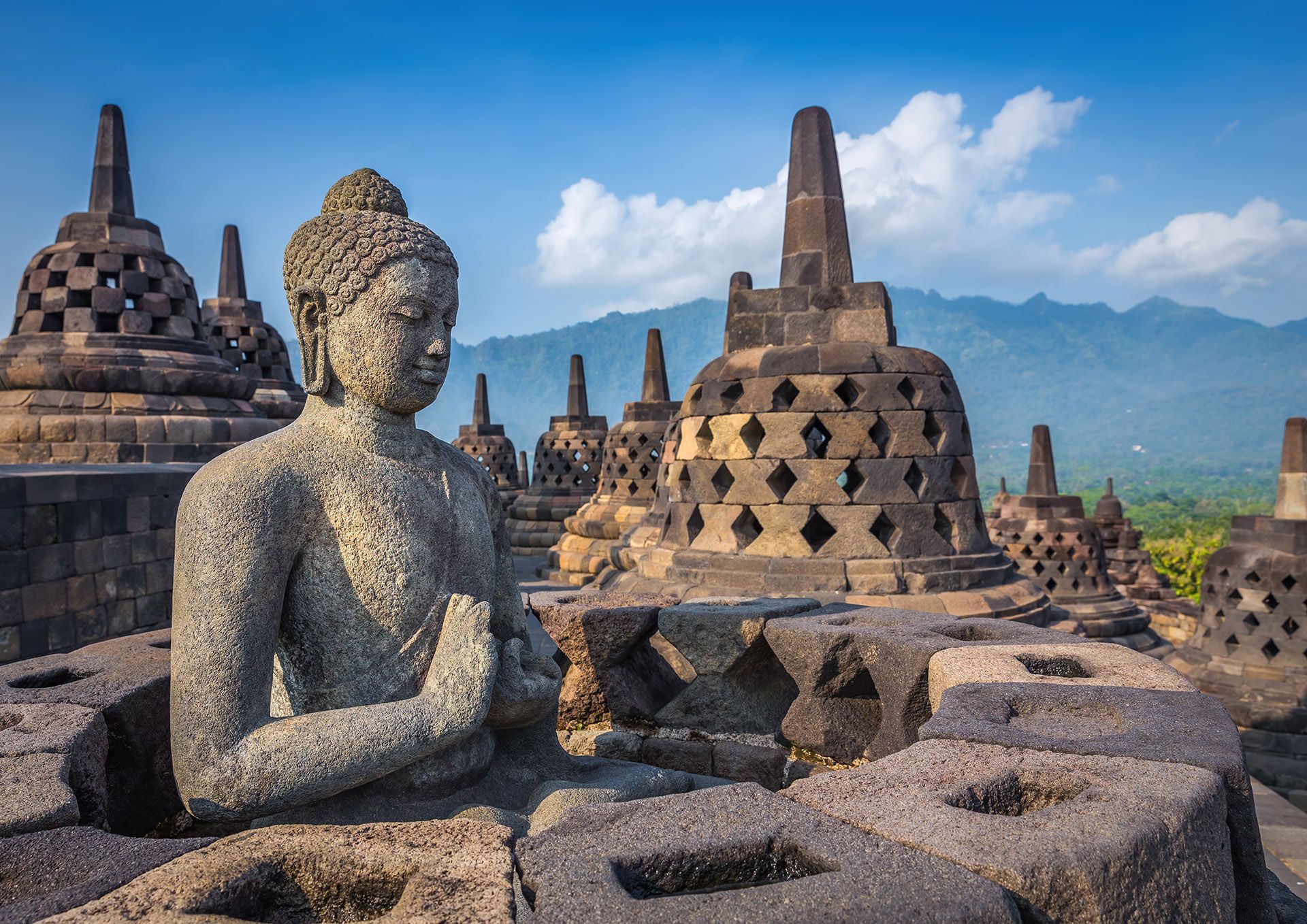
Majestic Buddha statue at Borobudur © Bule Sky Studio/Shutterstock
Reaching Borobudur Stress-Free
Fly into Yogyakarta
Most visitors land at Yogyakarta International Airport, just an hour’s drive from the temple. Direct flights connect from Bali, Singapore, Kuala Lumpur, and major Indonesian cities.
Ground Transport Options
Bus: Regular services from Yogyakarta’s Jombor Terminal
Ride-hailing: Grab or Go-Jek apps offer instant taxis
Bike rentals: Fun way to explore from local guesthouses
Pro tip: Combine your Borobudur visit with Java’s cultural hub Yogyakarta – famous for batik workshops, royal palaces, and jaw-dropping street food.


🌟 The Travaloca Travel Editors Community is a dynamic collective of individuals united by their passion for travel and their dedication to high-quality content creation. This community serves as the driving force behind Travaloca's informative and engaging travel resources. ✨ Core Identity: This group consists primarily of passionate travel enthusiasts who have turned their love for exploration into a commitment to writing and content curation. Members are recognized for their: Extensive Travel Experience: Possessing valuable firsthand knowledge from their journeys worldwide. Aptitude for Writing and Editing: Demonstrating a keen interest and skill in crafting, reviewing, and perfecting travel narratives, guides, tips, and reviews. Dedication to Storytelling: Transforming personal experiences and destination knowledge into accessible, inspiring, and reliable information for a global audience. 📝 Community Focus: The community’s primary role is to contribute, edit, and maintain the diverse range of content on Travaloca's platform. They ensure the information provided is accurate, engaging, and reflective of current travel trends. In essence, the Travaloca Travel Editors Community is where travel passion meets editorial excellence, enriching the user experience and solidifying Travaloca’s standing as a trusted travel resource.


